
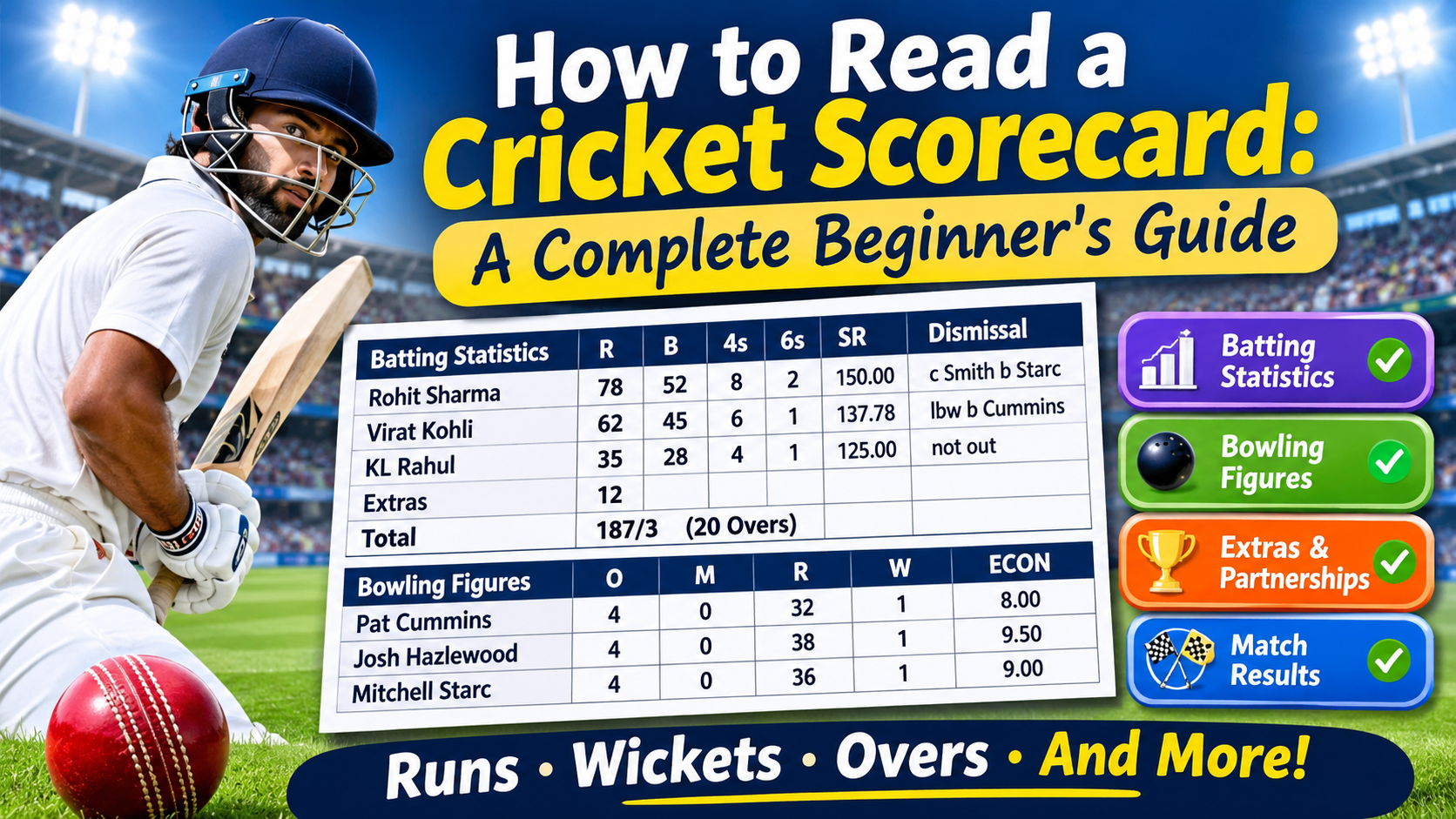
How to Read a Cricket Scorecard: A Complete Beginner’s Guide
Cricket is one of the most popular sports in the world. From international tournaments and domestic leagues to exciting T20 competitions, millions of people follow cricket matches every day. However, watching a match is only one part of understanding the game. To understand what is actually happening on the field, it is equally important to know how to read a cricket scorecard.
For someone new to cricket, a scorecard can initially look confusing. It contains numbers, abbreviations, player names, batting statistics, bowling figures, extras, partnerships, and other match details. You might see a player scoring 75 runs, a bowler taking three wickets, or a team reaching 185/6 in 20 overs. But what do these numbers really mean?
A cricket scorecard provides a structured summary of a match. It helps readers understand how many runs a team scored, how many wickets were lost, which batters performed well, which bowlers contributed to the game, and how the final result was decided.
The good news is that reading a cricket scorecard is not difficult once you understand its basic sections. You do not need to be an experienced cricket follower or an expert analyst. Learning a few common cricket terms and statistics can help you understand match results much more confidently.
In this complete beginner’s guide, we will explain the different parts of a cricket scorecard, including batting statistics, bowling figures, extras, overs, partnerships, fall of wickets, and match results. We will also use simple examples to make each concept easier to understand.
Whether you are watching your first cricket match or trying to improve your general cricket knowledge, this guide will help you understand the numbers behind the game.
1. What Is a Cricket Scorecard?
A cricket scorecard is a statistical record of a cricket match. It displays the performance of both teams and provides information about individual players throughout their innings.
Think of it as a match report presented through numbers rather than paragraphs. Instead of reading a long description of every delivery, you can look at a scorecard and quickly understand the important events.
A standard cricket scorecard generally includes:
- Team names and match details.
- Total runs scored by each team.
- Number of wickets lost.
- Overs and balls played.
- Individual batting performances.
- Bowling figures and wickets taken.
- Extras awarded during the innings.
- Fall of wickets.
- Final match result.
For example, consider this score:
Team A – 185/6 (20 Overs)
This means:
- Team A scored 185 runs.
- Six batters were dismissed.
- The team completed its 20 overs.
- Four wickets remained unused when the innings ended.
If you understand this one line, you already know the basic structure of a cricket scorecard.
However, the remaining statistics provide more information about how the team reached that total.
2. Understanding Runs, Wickets and Overs
Before exploring individual player statistics, it is important to understand three fundamental cricket terms: runs, wickets, and overs.
These three elements form the foundation of every cricket score.
What Are Runs in Cricket?
Runs represent the points scored by a batting team. The main objective of the batting side is to score as many runs as possible while avoiding the loss of all available wickets.
There are several ways to score runs:
1. Running between the wickets
After hitting the ball, two batters can run between the wickets. Each completed run adds one run to the team’s total.
2. Four runs
When the batter hits the ball and it reaches or crosses the boundary after touching the ground, four runs are awarded.
3. Six runs
When the batter hits the ball beyond the boundary without it touching the ground inside the playing area, six runs are awarded.
4. Extras
Runs can also be awarded through wides, no-balls, byes, and leg-byes. These are included in the team total but are not credited to an individual batter.
What Are Wickets?
A wicket represents the dismissal of a batter. Each team normally has ten wickets available in an innings.
When ten batters have been dismissed, the innings ends, even if some overs remain.
For example:
- 150/2 means 150 runs and two wickets lost.
- 150/5 means 150 runs and five wickets lost.
- 150/9 means 150 runs and nine wickets lost.
- 150 all out means the team scored 150 runs before losing all ten wickets.
Wickets are important because losing them reduces the number of batters available to continue scoring.
What Are Overs?
An over is a set of six valid deliveries bowled by one bowler from one end of the pitch.
In standard limited-overs cricket:
- T20 matches generally have 20 overs per team.
- One Day International matches generally have 50 overs per team.
- Test cricket does not have a fixed number of overs per innings.
You may see an over written as 15.4 on a scorecard.
This does not mean fifteen and four-tenths overs. It means 15 completed overs and four valid balls of the next over.
This distinction is important when calculating the remaining balls in an innings.
3. How to Read the Main Scorecard Format
Let’s understand a simple example.
Example: T20 Match Scorecard
Team A
185/6
20 Overs
Team B
172/8
20 Overs
Illustrative result
Team A won by 13 runs.
What can we understand from this example?
Team A scored 185 runs after completing 20 overs and losing six wickets. Team B then scored 172 runs in its 20 overs while losing eight wickets.
The difference between the two totals is:
185 − 172 = 13 runs.
Therefore, Team A won the match by 13 runs.
This is how the headline score helps you understand the result before looking at the detailed player statistics.
4. Understanding Batting Statistics
The batting section is one of the most important parts of a cricket scorecard. It shows how each batter contributed to the team’s total.
Players are generally listed according to the order in which they came out to bat.
A typical batting scorecard contains several columns.
| Abbreviation | Meaning |
|---|---|
| R | Runs scored |
| B | Balls faced |
| 4s | Number of fours |
| 6s | Number of sixes |
| SR | Batting strike rate |
| Dismissal | How the batter got out |
Let’s understand each statistic individually.
Runs (R)
The runs column displays how many runs an individual batter scored during their innings.
For example:
If a batter scores 65 runs, the scorecard displays 65 under the R column.
A batter who scores 100 runs achieves a century, while a score of 50 is called a half-century.
These milestones are commonly used to describe individual batting performances.
Balls Faced (B)
The balls column indicates how many deliveries a batter faced.
For example:
If a player scores 60 runs from 40 balls, their batting performance is recorded as:
- Runs: 60
- Balls: 40
This information helps readers understand how quickly the batter scored.
Remember that wides generally do not count as balls faced, while a no-ball does count as a ball faced by the batter.
Fours (4s)
The 4s column records the number of boundaries hit for four runs.
For example, if a batter hits seven fours, the scorecard displays 7 in this column.
Seven fours contribute 28 runs to that batter’s score.
Sixes (6s)
The 6s column records the number of six-run shots hit by a batter.
For example, four sixes contribute 24 runs.
This statistic helps readers understand how frequently a batter scored through powerful boundary shots.
Strike Rate (SR)
Strike rate is one of the most useful batting statistics, especially in T20 and ODI cricket.
It measures how many runs a batter scores per 100 balls faced.
The formula is:
\[ SR = \frac{\text{Runs Scored}}{\text{Balls Faced}}\times100 \]
Example:
A batter scores 60 runs from 40 balls.
\[ SR = \frac{60}{40}\times100=150 \]
The batter’s strike rate is 150.00.
A higher strike rate generally indicates faster scoring, although the value should always be considered in the context of the match situation and format.
In Test cricket, a batter may focus more on spending time at the crease and protecting their wicket. In T20 cricket, scoring quickly is often a bigger priority.
5. How to Understand Bowling Figures
After the batting statistics, the bowling section explains how the bowlers performed.
It records the number of overs bowled, runs conceded, wickets taken, and other important details.
A typical bowling scorecard contains these columns:
| Abbreviation | Meaning |
|---|---|
| O | Overs bowled |
| M | Maiden overs |
| R | Runs conceded |
| W | Wickets taken |
| ECON | Economy rate |
| WD | Wides bowled |
| NB | No-balls bowled |
Overs (O)
This column shows how many overs a bowler completed.
For example, 4 overs means the bowler delivered four completed overs.
In a standard T20 innings, a bowler can usually bowl a maximum of four overs, subject to the applicable playing conditions.
Maiden Overs (M)
A maiden over is an over in which no runs are charged to the bowler.
A maiden over demonstrates effective bowling because the bowler prevents the batting side from adding runs against their bowling figures.
A maiden over cannot contain a wide or no-ball.
Runs Conceded (R)
The runs column shows how many runs were charged against a bowler.
For example, if a bowler concedes 32 runs, the bowling statistics display 32 in the R column.
It is worth remembering that byes and leg-byes are not charged to the bowler.
Wickets (W)
This column records the number of wickets credited to the bowler.
For example, a bowler who dismisses three batters through credited dismissals has taken three wickets.
However, not every dismissal is credited to the bowler. Run-outs, for example, are generally not counted as wickets in the bowler’s figures.
Economy Rate (ECON)
Economy rate indicates how many runs a bowler concedes per over on average.
The formula is:
\[ ECON=\frac{\text{Runs Conceded}}{\text{Overs Bowled}} \]
For example:
A bowler concedes 30 runs in five overs.
\[ ECON=\frac{30}{5}=6.00 \]
The bowler’s economy rate is 6.00.
In limited-overs cricket, a lower economy rate can indicate that the bowler has restricted the scoring rate.
Example of Bowling Figures
Consider these illustrative figures:
| Bowler | O | M | R | W |
|---|---|---|---|---|
| Player A | 4 | 0 | 25 | 2 |
| Player B | 4 | 1 | 28 | 3 |
| Player C | 4 | 0 | 36 | 1 |
| Player D | 4 | 0 | 32 | 1 |
| Player E | 4 | 0 | 42 | 1 |
Player B took three wickets and conceded 28 runs in four overs. Player A took two wickets and conceded 25 runs.
Both players made useful contributions, but Player B took more wickets while Player A conceded fewer runs.
Looking at both wickets and economy rate provides a more complete understanding of bowling performance.
6. What Are Extras in a Cricket Scorecard?
Extras are runs added to the team’s total that are not credited to an individual batter.
They are an important part of a scorecard because they help explain the difference between the sum of individual batting scores and the team’s total.
The main types of extras are:
Byes (B)
Byes are runs scored when the ball passes the batter without touching the bat or body and the batters complete runs, or the ball reaches the boundary.
These runs are added to the team’s total but are not charged to the bowler.
Leg-Byes (LB)
Leg-byes occur when the ball touches the batter’s body rather than the bat and the batters complete runs, subject to the relevant playing conditions.
They are also not charged to the bowler.
Wides (WD)
A wide is an illegal delivery that is considered too far from the batter to play a reasonable shot.
A wide generally adds one extra run to the batting team’s total, with additional runs possible depending on what happens after the delivery.
Wides are charged to the bowler.
No-Balls (NB)
A no-ball is an illegal delivery under the applicable cricket rules.
It usually awards one extra run, with additional runs possible depending on the circumstances.
A no-ball is charged to the bowler and can also give the batter a free hit in limited-overs formats under the relevant playing conditions.
Example of Extras
Suppose a team scores:
| Extra Type | Runs |
|---|---|
| Byes | 3 |
| Leg-byes | 2 |
| Wides | 5 |
| No-balls | 1 |
| Total Extras | 11 |
The team’s extras total is 11 runs.
If the batters collectively score 174 runs, the team total becomes:
174 + 11 = 185 runs.
This explains why a team’s total can be higher than the combined individual batting scores.
7. Understanding How a Batter Gets Out
Another important section of a cricket scorecard is the dismissal column.
This section explains how an individual batter lost their wicket.
Some dismissal abbreviations may appear unfamiliar to beginners, but they become easy to understand with practice.
Bowled (b)
A batter is bowled when a legal delivery hits the stumps and dislodges the bails.
Example:
b Bumrah
This means the batter was bowled by Bumrah.
Caught (c)
A batter is caught when a fielder catches the ball after it touches the bat or glove, before it touches the ground, subject to the laws of cricket.
Example:
c Smith b Starc
This means Smith caught the batter off Starc’s bowling.
LBW (Leg Before Wicket)
LBW stands for Leg Before Wicket.
It occurs when the ball hits the batter’s body and prevents it from hitting the stumps, under the conditions specified in the cricket laws.
Example:
lbw b Anderson
This means the batter was dismissed LBW off Anderson’s bowling.
Run Out
A run-out occurs when a batter is outside their ground and the wicket is fairly broken by the fielding side while a run is being attempted or completed.
Example:
run out (Jadeja)
This indicates a run-out involving Jadeja.
Stumped (st)
A batter can be stumped when the wicketkeeper breaks the wicket while the batter is outside their ground and is not attempting a run, subject to the applicable laws.
Example:
st Pant b Ashwin
This means Pant stumped the batter off Ashwin’s bowling.
Caught and Bowled (c & b)
This happens when the bowler catches the ball directly after the batter hits it, before it touches the ground.
Example:
c & b Jadeja
The bowler Jadeja took the catch.
Hit Wicket
A batter is dismissed hit wicket when they break their own wicket while playing a shot or immediately after certain actions, as defined by the cricket laws.
Not Out
If a batter is still at the crease when the innings finishes, the scorecard marks them as not out.
For example:
Virat Kohli – 72*
The asterisk indicates that the batter remained unbeaten on 72 runs.
8. What Is Fall of Wickets (FOW)?
Fall of wickets, commonly abbreviated as FOW, shows the team score at which each wicket was lost.
It helps readers understand when important dismissals happened during an innings.
For example:
| Wicket | Team Score | Batter |
|---|---|---|
| 1st | 24 | Player A |
| 2nd | 65 | Player B |
| 3rd | 102 | Player C |
| 4th | 140 | Player D |
| 5th | 165 | Player E |
What does this information tell us?
The first wicket fell when the team had scored 24 runs. The second wicket fell at 65, and the third at 102.
This gives readers an idea of how the innings developed.
For example, if a team loses four wickets within the first 30 runs, it suggests an early batting collapse. If the first wicket falls after 100 runs, the opening partnership has provided a strong start.
Fall of wickets statistics are particularly useful when analysing match momentum.
9. Understanding Partnerships in Cricket
A partnership refers to the runs scored by two batters together while they are batting at the crease.
Cricket partnerships are important because they show how well two players work together to build an innings.
For example:
- First-wicket partnership: 55 runs.
- Second-wicket partnership: 42 runs.
- Third-wicket partnership: 68 runs.
The third-wicket partnership contributed 68 runs to the team’s innings.
A strong partnership can help a team recover after losing early wickets or increase the scoring rate during the middle overs.
Partnership statistics also provide context to individual performances.
For example, a batter scoring 80 runs may have built a match-winning partnership with another player who contributed 35 runs.
Together, their efforts may have changed the direction of the match.
10. Understanding Run Rate and Required Run Rate
Run rate is another important statistic displayed on many live cricket scorecards.
It indicates how many runs a team scores per over on average.
Current Run Rate (CRR)
The current run rate is calculated using the total runs scored divided by the number of overs completed, including the balls bowled in the current over.
Formula:
\[ CRR=\frac{\text{Total Runs}}{\text{Overs Bowled}} \]
For example:
A team scores 90 runs in 10 overs.
\[ CRR=\frac{90}{10}=9 \]
The current run rate is 9 runs per over.
Required Run Rate (RRR)
Required run rate indicates how many runs per over a chasing team needs to score to reach its target.
For example:
- Target: 181 runs.
- Current score: 121 runs.
- Remaining runs: 60.
- Overs remaining: 5.
\[ RRR=\frac{60}{5}=12 \]
The chasing team needs to score at 12 runs per over to win.
This statistic is especially useful when following T20 and ODI matches.
11. How to Read a Complete Cricket Scorecard: Practical Example
Now that we understand the individual sections, let’s combine everything into one simple example.
The following scorecard is fictional and created only for educational purposes.
Team A Batting
Team A – 185/6
20 overs · Illustrative scorecard
| Batter | R | B | 4s | 6s | SR |
|---|---|---|---|---|---|
| Player A | 45 | 30 | 5 | 2 | 150.00 |
| Player B | 32 | 24 | 3 | 1 | 133.33 |
| Player C | 58 | 35 | 4 | 3 | 165.71 |
| Player D | 18 | 12 | 1 | 1 | 150.00 |
| Player E | 12 | 8 | 1 | 0 | 150.00 |
| Player F | 5 | 4 | 0 | 0 | 125.00 |
| Player G | 3* | 2 | 0 | 0 | 150.00 |
| Extras | 12 | ||||
| Total | 185/6 | 20 ov |
Let’s interpret the batting statistics.
Player C was the highest scorer with 58 runs from 35 balls. Their strike rate was 165.71, which indicates a relatively quick scoring rate.
Player A contributed 45 runs from 30 deliveries, while Player B scored 32 runs from 24 balls.
The extras column shows 12 additional runs.
The combined runs from the listed batters and extras make up the team total.
Team B Bowling
| Bowler | O | M | R | W |
|---|---|---|---|---|
| Bowler A | 4 | 0 | 32 | 2 |
| Bowler B | 4 | 0 | 28 | 1 |
| Bowler C | 4 | 0 | 40 | 1 |
| Bowler D | 4 | 0 | 35 | 1 |
| Bowler E | 4 | 0 | 38 | 1 |
The bowling figures show that Bowler A took two wickets and conceded 32 runs.
Bowler B conceded 28 runs, the lowest among the five bowlers, and took one wicket.
The bowling section helps explain how the bowling team tried to control the opposition’s scoring.
Team B Batting
Team B – 172/8
20 overs · Illustrative scorecard
| Batter | Runs | Balls |
|---|---|---|
| Player H | 40 | 28 |
| Player I | 35 | 25 |
| Player J | 27 | 19 |
| Player K | 22 | 16 |
| Player L | 18 | 12 |
| Player M | 10 | 8 |
| Player N | 8 | 6 |
| Player O | 5 | 4 |
| Extras | 7 | |
| Total | 172/8 | 20 ov |
Team B scored 172 runs and lost eight wickets.
Team A scored 185 runs, which means Team B finished 13 runs behind the target.
Final result: Team A won by 13 runs.
This example demonstrates how batting statistics, bowling figures, extras, and the final score work together to explain a cricket match.
12. Differences Between T20, ODI and Test Match Scorecards
Although the basic scorecard structure remains similar, different cricket formats have different rules and match conditions.
T20 Cricket
Each team generally receives 20 overs. Batting strike rate, boundaries, wickets, and required run rate are particularly important. A high-scoring innings can change the match quickly.
What is Virat Kohli’s record at Wankhede Stadium in international cricket?
One Day International (ODI)
Each team generally receives 50 overs. The scorecard provides insight into powerplay performance, middle-over partnerships, batting depth, and final-over scoring.
Test Cricket
Test matches can last up to five days. Each team normally has two innings. The scorecard may include declarations, follow-ons, innings totals, and detailed batting and bowling records.
How Test Match Scores Are Different
In Test cricket, a team may bat twice.
For example:
- Team A first innings: 350 all out.
- Team B first innings: 280 all out.
- Team A second innings: 200/5 declared.
- Team B second innings: Target of 271 runs.
The scorecard displays separate innings because the match has a different structure from limited-overs cricket.
Understanding these differences makes it easier to interpret scorecards from different formats.
13. Common Cricket Scorecard Abbreviations Beginners Should Know
When checking a cricket scorecard, you may come across several short forms.
Here is a useful reference table:
| Abbreviation | Full Meaning |
|---|---|
| R | Runs |
| B | Balls faced |
| O | Overs |
| M | Maiden overs |
| W | Wickets |
| R (bowling) | Runs conceded |
| SR | Strike rate |
| ECON | Economy rate |
| CRR | Current run rate |
| RRR | Required run rate |
| FOW | Fall of wickets |
| 4s | Fours |
| 6s | Sixes |
| WD | Wides |
| NB | No-balls |
| LBW | Leg Before Wicket |
| DNB | Did Not Bat |
| NR | No Result |
| RR | Run rate |
Learning these abbreviations will make most standard cricket scorecards easier to understand.
14. Common Mistakes Beginners Make While Reading a Scorecard
Even people who regularly watch cricket sometimes misunderstand certain statistics.
Here are some common mistakes worth avoiding.
Mistake 1: Confusing Runs with Wickets
A score of 150/5 does not mean 150 wickets or five runs. It means 150 runs scored and five wickets lost.
Mistake 2: Reading Overs as Decimal Numbers
An over written as 10.4 means ten completed overs and four balls, not 10.4 decimal overs.
Mistake 3: Assuming Every Wicket Is Credited to the Bowler
Run-outs and certain other dismissals are not credited to the bowler. Therefore, the total number of wickets lost by a team may be higher than the combined wickets recorded against its bowlers.
Mistake 4: Ignoring Extras
A batter’s individual score is not necessarily equal to the total contribution shown by the team’s scoreboard. Extras must also be included.
Mistake 5: Comparing Strike Rates Without Match Context
A strike rate of 120 may be useful in a Test innings but may be relatively slow in some T20 situations. Always consider the format and match circumstances.
Mistake 6: Looking Only at Wickets
A bowler who takes one wicket while conceding very few runs can still make an important contribution.
Similarly, a batter who scores 35 runs from 15 balls may provide valuable momentum even without reaching a half-century.
A scorecard should always be read as a complete record rather than a collection of isolated numbers.
15. How to Analyse a Cricket Match Using a Scorecard
Reading numbers is useful, but understanding what those numbers reveal about the match is even more valuable.
You can follow a simple approach whenever you open a cricket scorecard.
Step 1: Check the final score
Start by checking the total runs, wickets lost, and overs played. This gives you an immediate understanding of the team’s performance.
Step 2: Identify the top batters
Look for the highest individual scores and compare the number of balls faced. This helps identify which batters contributed significantly.
Step 3: Check the batting strike rates
Compare the strike rates to understand which players scored quickly and which players focused on building an innings.
Step 4: Review bowling performances
Check the wickets taken, runs conceded, and economy rates. This helps you understand which bowlers controlled the scoring and created important breakthroughs.
Step 5: Look at partnerships
Partnerships explain how batters combined their efforts. They can reveal whether a team built its innings steadily or recovered from an early setback.
Step 6: Understand the final result
Finally, check whether the team won by runs, wickets, or an innings. This completes your understanding of the match.
Following these six steps can make cricket statistics much easier to understand.
16. Why Understanding Cricket Scorecards Is Important
Cricket scorecards are useful for more than simply checking who won a match.
They provide information that helps viewers, cricket enthusiasts, players, and sports students understand different aspects of the game.
Some important benefits include:
- Better match understanding: Scorecards explain how teams reached their final totals.
- Player performance analysis: Individual batting and bowling figures help compare performances.
- Match progress tracking: Wickets, overs, and run rates help explain the changing match situation.
- Historical records: Scorecards preserve important match statistics for future reference.
- Cricket knowledge: Understanding common terms makes cricket discussions easier to follow.
- Performance comparisons: Readers can compare players across different matches and formats.
For beginners, learning how to interpret these details is a practical way to develop a deeper understanding of cricket.
17. Following Cricket Information and Developing Better Match Knowledge
Today, cricket fans have access to several digital resources that make following the sport easier. Online sports platforms, cricket websites, match reports, and scorecard services provide different types of cricket-related information.
However, readers should understand the difference between general cricket information, official match statistics, commentary, and opinion-based content.
When checking a cricket match:
- Prefer recognised cricket organisations and established scorecard providers for official statistics.
- Check the match date and tournament details.
- Understand whether the scorecard is live or final.
- Compare important statistics with reliable match records.
- Avoid accepting unverified performance claims or misleading match information.
Readers interested in exploring cricket-related online content can also visit Tiger365Pro.live.
The important point is to approach online cricket information carefully. A website’s presence does not automatically establish the accuracy of every statistic or claim it publishes. Always check relevant information independently.
Cricket should also be enjoyed responsibly. Where online services involve financial participation or betting, users should understand the risks, check applicable local laws, and avoid risking money they cannot afford to lose.
18. Frequently Asked Questions (FAQs)
Here are some common questions beginners ask when learning how to read a cricket scorecard.
1. What is a cricket scorecard?
A cricket scorecard is a statistical record of a cricket match. It displays team totals, individual batting scores, bowling figures, wickets, overs, extras, partnerships, and match results.
2. What does 185/6 mean in cricket?
A score of 185/6 means the batting team has scored 185 runs and lost six wickets. The team has four wickets remaining.
3. What does SR mean on a cricket scorecard?
SR stands for Strike Rate. For a batter, it measures the number of runs scored per 100 balls faced. A higher strike rate generally indicates faster scoring.
4. What does ECON mean in bowling?
ECON stands for Economy Rate. It shows the average number of runs a bowler concedes per over.
5. What does O mean in bowling statistics?
O represents Overs. It indicates the number of completed overs bowled by a particular player.
6. What does M mean in a bowling scorecard?
M represents Maiden Overs. A maiden over is a completed over in which no runs are charged to the bowler.
7. What is the meaning of FOW in cricket?
FOW means Fall of Wickets. It shows the team score at which each batter was dismissed during an innings.
8. What are extras in cricket?
Extras are runs added to the team’s total but not credited to individual batters. They include wides, no-balls, byes, and leg-byes.
9. What does not out mean?
Not out means a batter was still at the crease when the innings ended. The player was not dismissed during that innings.
10. What does DNB mean?
DNB stands for Did Not Bat. It indicates that a listed player did not get an opportunity to bat during that innings.
11. What does 3/25 mean in bowling?
It generally means the bowler took three wickets and conceded 25 runs. Some scorecards display the figures as 3-25, depending on their format.
12. What is the difference between a batting strike rate and bowling economy?
Batting strike rate measures runs scored per 100 balls faced. Bowling economy measures runs conceded per over bowled. Both statistics help evaluate different aspects of player performance.
13. How many wickets are available to a cricket team?
A team normally has ten wickets in an innings. Once all ten batters are dismissed, the innings ends.
14. What does all out mean?
All out means a team has lost all ten wickets. Its innings ends even if the allotted overs have not been completed.
15. How can beginners improve their understanding of cricket scorecards?
Beginners can start by learning runs, wickets, overs, batting strike rates, bowling economy, and extras. Regularly reading scorecards and comparing them with match reports can gradually improve their understanding.
Conclusion
Learning how to read a cricket scorecard is one of the simplest ways to develop better cricket knowledge. Although the numbers and abbreviations may appear complicated at first, each section has a specific purpose.
The team total explains how many runs were scored and how many wickets were lost. Batting statistics show individual contributions, while bowling figures reveal how effectively bowlers performed. Extras, partnerships, and fall of wickets provide additional details about the progress of an innings.
Understanding the difference between T20, ODI, and Test match scorecards also helps readers interpret statistics according to the format being played.
You do not need to memorise every cricket term immediately. Start with the basic abbreviations, understand the main statistics, and practise reading different scorecards.
With regular practice, you will become more comfortable understanding match results, comparing player performances, and following cricket discussions.
For additional cricket-related online content, visit Tiger365Pro.live and continue developing your general knowledge of the sport while relying on independently verified cricket information.
Remember: A cricket scorecard is more than a collection of numbers. It is a record of the performances, partnerships, challenges, and important moments that shape every cricket match.